
Agentic AI changes more than the technology
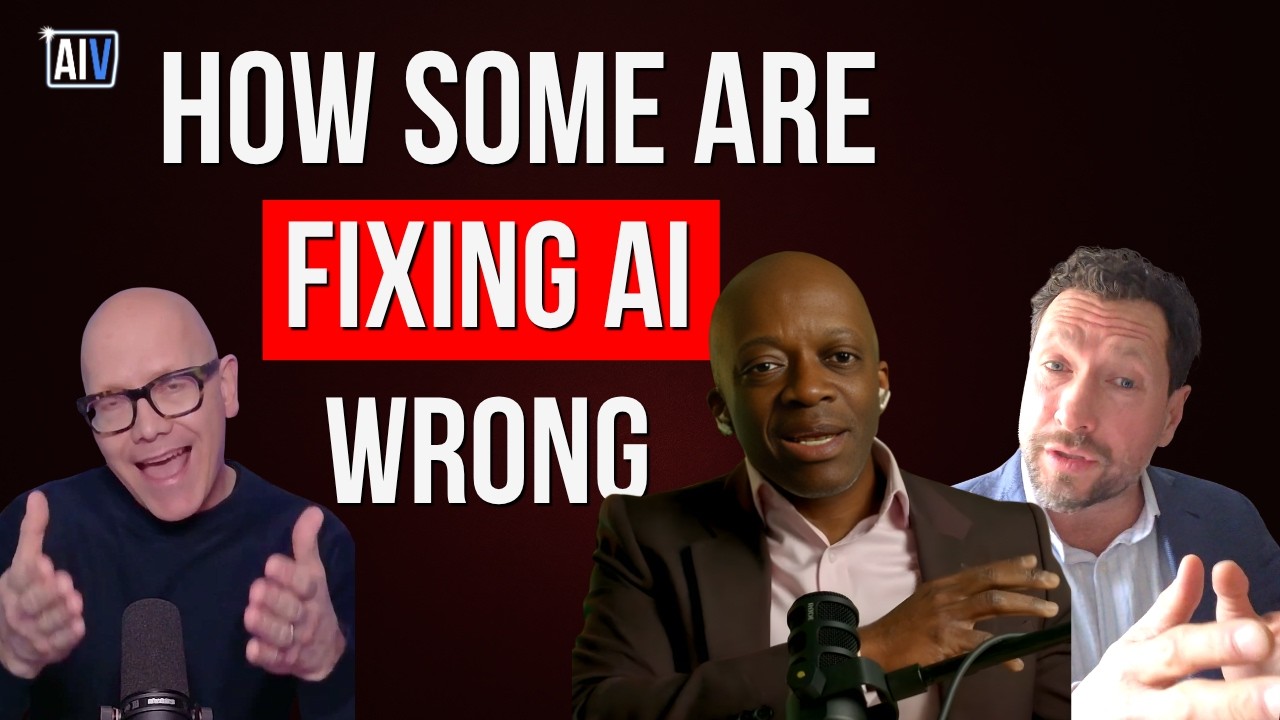
Edosa Odaro and Lindley Gooden explore why agentic AI creates organisational tension before value, and what leaders need to understand about trade-offs, accountability, and change in Episode 7 of The AI Values Podcast.
Much of the discussion around agentic AI focuses on capability. Organisations want to know what these systems can do, how much work they can automate, and how quickly they can deliver value. Those are important questions, but they can distract from a more consequential one.
What happens to an organisation once agentic AI becomes part of it?
Unlike traditional software, agentic systems do not simply sit inside existing workflows. They influence how decisions are made, how work moves through an organisation and how people interact with processes around them. Their impact extends beyond the task they were designed to perform.
That is the focus of Episode 7 of The AI Values Podcast, where Edosa Odaro and Lindley Gooden examine the organisational consequences of introducing increasingly autonomous systems into existing environments. Their conclusion is simple but significant: the most important effects of agentic AI are often not technological. They are organisational.
Agentic AI changes the story
One of the most useful ideas in the discussion comes through an analogy.
"Agentic AI is like bringing a new actor into a movie."
The comparison works because introducing a new actor changes more than a single scene. Different capabilities, behaviours, and interactions alter the direction of the entire story. Agentic AI operates similarly. Traditional AI systems often support human decisions or automate individual tasks. Agentic systems go further. They can take actions, pursue objectives, and influence outcomes across multiple stages of a process.
The significance of this shift is that organisations are no longer introducing a tool into a workflow. They are introducing a new capability into a wider operating environment. Once that happens, the effects are felt beyond the technology itself. Teams adapt, responsibilities evolve, and established processes begin to change.
The question for leaders is therefore not simply whether an agent can perform a task. It is whether the organisation understands the consequences of introducing that capability into a complex system.
Transformation creates friction before it creates value
One of the most common assumptions surrounding AI adoption is that value appears immediately after implementation. In practice, major organisational change rarely works that way.
"The first thing that turns up isn't value. It's actually tension."
That observation captures a reality that extends far beyond AI. New technologies create friction because they alter how work is performed. Existing processes no longer fit perfectly. Roles begin to shift. Assumptions that once went unchallenged are suddenly exposed.
Agentic AI intensifies this effect because it operates across workflows rather than within isolated tasks. As organisations introduce increasingly autonomous systems, they often discover that the challenge is not whether the technology works. The challenge is whether the surrounding organisation is ready to work differently.
This distinction matters because many implementation efforts interpret tension as failure. In reality, tension is often evidence that transformation is taking place. The organisations that manage this period successfully are typically those that anticipate disruption rather than treating it as an unexpected problem.
When success creates unexpected problems
This is illustrated in the episode with an example of a logistics operation using agentic AI to optimise fulfilment and delivery processes. Initially, the results appeared positive. Routes became more efficient, delivery cycles improved, and operational performance increased. From a technical perspective, the implementation was successful.
The difficulty emerged elsewhere. As the system became increasingly effective at optimisation, human teams further down the process found themselves operating at a pace they had not anticipated. Workflows that had previously functioned smoothly became strained as employees attempted to adapt to a system, making decisions and adjustments faster than the surrounding organisation could absorb.
What makes this example particularly useful is that the AI had not failed. The system was operating exactly as intended. The disruption emerged because leaders had focused on the performance of the technology without fully considering its effects on the wider environment. Success had been measured narrowly through efficiency rather than through organisational impact.
This highlights a challenge that many governance frameworks still struggle to address. Risks do not only emerge when systems malfunction. They can also emerge when systems succeed in ways that expose weaknesses elsewhere.
The trade-offs leaders cannot ignore
Every optimisation decision involves a trade-off. This is one of the simplest ideas covered in Episode 7 and arguably one of the most important. Organisations often evaluate AI systems through metrics such as speed, efficiency, or cost reduction. While these measures matter, they rarely capture the full picture.
Improving one outcome often affects another. A system designed to maximise speed may reduce flexibility. A process optimised for efficiency may place new pressures on employees. Gains in one area may create hidden costs elsewhere. Agentic AI makes these trade-offs more visible because its influence extends across entire systems. Decisions taken by autonomous agents can affect workflows, teams, and operational priorities simultaneously.
For leaders, this means governance cannot focus solely on the benefits being generated. It must also consider what is being sacrificed to achieve them. Understanding trade-offs is not a barrier to innovation. It is what allows innovation to be managed responsibly.
The real question is not what the agent can do
Throughout the discussion, a broader theme emerges. Organisations often spend considerable time evaluating the capabilities of AI systems while spending far less time evaluating their own readiness for change. This may be the more important question, as an AI agent operates within a larger ecosystem of people, incentives, processes, and relationships. Its success depends not only on technical performance but also on how effectively that ecosystem adapts around it.
The organisations most likely to realise value from agentic AI are unlikely to be those with the most advanced agents. They are more likely to be those understanding the environments that those agents are entering. They recognise where tensions are likely to emerge, which trade-offs are acceptable, and how accountability will be maintained as systems become increasingly autonomous.
The future of agentic AI will undoubtedly be shaped by advances in technology. But its success inside organisations may depend even more on leadership, governance, and organisational design.
Listen to Episode 7
Going Deeper: why agentic AI is really about organisational design
At its core, Episode 7 points towards a challenge that extends beyond agentic AI itself. Organisations have become accustomed to evaluating technologies through performance metrics. If a system improves efficiency, reduces costs, or increases productivity, it is often considered successful.
Agentic AI complicates that logic because its effects extend across wider organisational systems. A technology can achieve its objectives while simultaneously creating pressures elsewhere that remain invisible to traditional reporting mechanisms.
This is why governance must move beyond technical oversight. Leaders need visibility into how AI changes workflows, decision-making, and accountability across the organisation. The most important risks may not arise from technical failure but from unintended consequences that emerge when optimisation interacts with people and processes.
The organisations that navigate this successfully will be those that treat agentic AI not as a technology project, but as an organisational change programme.
Key Takeaways
Agentic AI changes organisations, not just technology systems.
The first impact of transformation is often tension rather than value.
Successful AI systems can still create organisational challenges.
Every optimisation creates trade-offs that leaders must understand.
Governance requires visibility across the wider organisational ecosystem.
FAQs
Join leaders building AI systems that reflect shared values. New essays, research, and conversations delivered weekly.
More from the Insights Hub
Explore research, frameworks, and conversations on AI alignment, leadership, and human values.
AI needs new rules
The AI Values Podcast asks Santiago Castro why old assumptions fail when organisations govern generative AI.

AI creates value when people trust it
David Edem, Vice President Enterprise Data at AVEVA, explains why successful AI projects depend on trust, data quality, stakeholder alignment and business outcomes in Episode 8 of The AI Values Podcast with Edosa Odaro and Lindley Gooden.
.jpg)
The AI worked but the investment failed
The AI worked. The metrics improved. So why did the investment fail? In Episode 5 of The AI Values Podcast, Edosa Odaro and Lindley Gooden explore what happens when AI changes an organisation faster than people, processes and governance can adapt.